
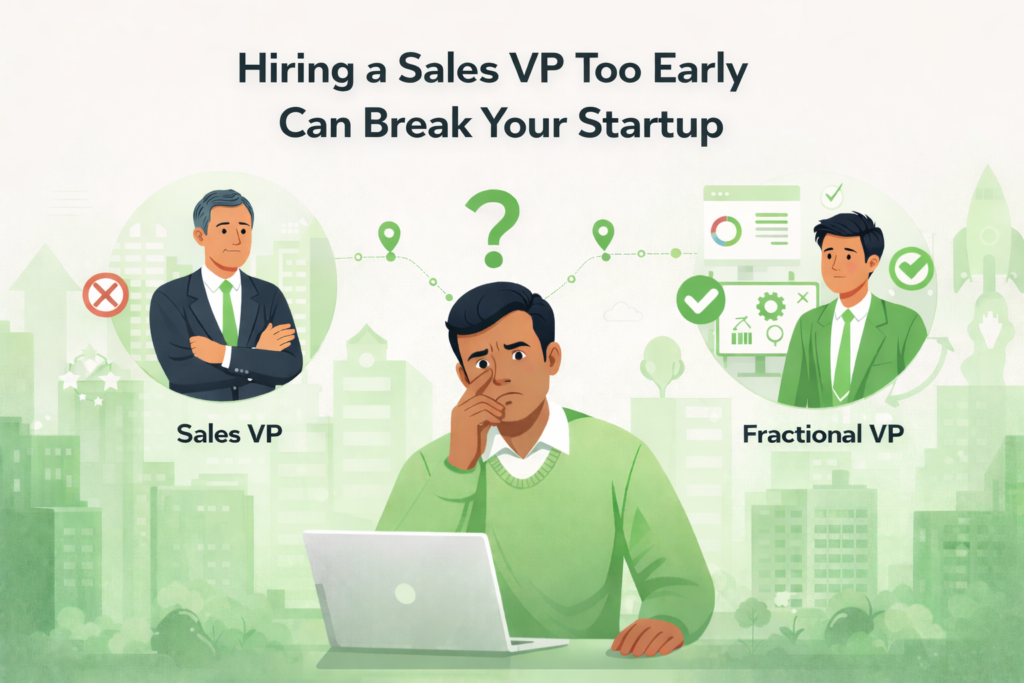
Why One Wrong Hire Can Cost You Million
Scaling beyond founder-led sales is one of the hardest transitions a startup will ever face.
If you’re a 50–200 employee B2B company planning to expand into the US, UK, Europe, or the Middle East, chances are this sounds familiar:
- You closed your early deals personally
- Referrals and networks powered initial growth
- A few outbound experiments worked… sporadically
- The founder is still deeply involved in every large deal
- Revenue exists, but it’s not predictable
At some point, a single thought dominates leadership conversations:
“We need a strong Sales VP to take this to the next level.”
On paper, this sounds like the right move.
In reality, this is where many startups make a very expensive mistake.
The Classic Mistake: Hiring a “Big Resume” Sales VP
When founders decide to hire a Sales VP, they often optimize for years of experience.
The logic usually looks like this:
- “We’re entering the US and Europe. We need someone senior.”
- “Let’s hire someone with 15–30 years of experience.”
- “They must have led large teams before.”
- “They should know enterprise sales.”
So startups go out and hire a highly experienced, high-cost Sales VP.
What could go wrong?
A lot.
The Hidden Reality of Scaling into New Markets
Let’s be brutally honest about the situation most startups are in at this stage.
You don’t actually have a sales engine yet.
You have:
- Individual hero sellers (often the founder)
- No documented GTM playbooks
- No ICP clarity for new geographies
- No SDR → AE motion that’s proven
- No RevOps discipline
- No predictable pipeline math
Now layer on new markets:
- US buyers behave very differently from Indian or APAC buyers
- UK and Europe require sharper ICP discipline
- Middle East relies heavily on relationships and local nuance
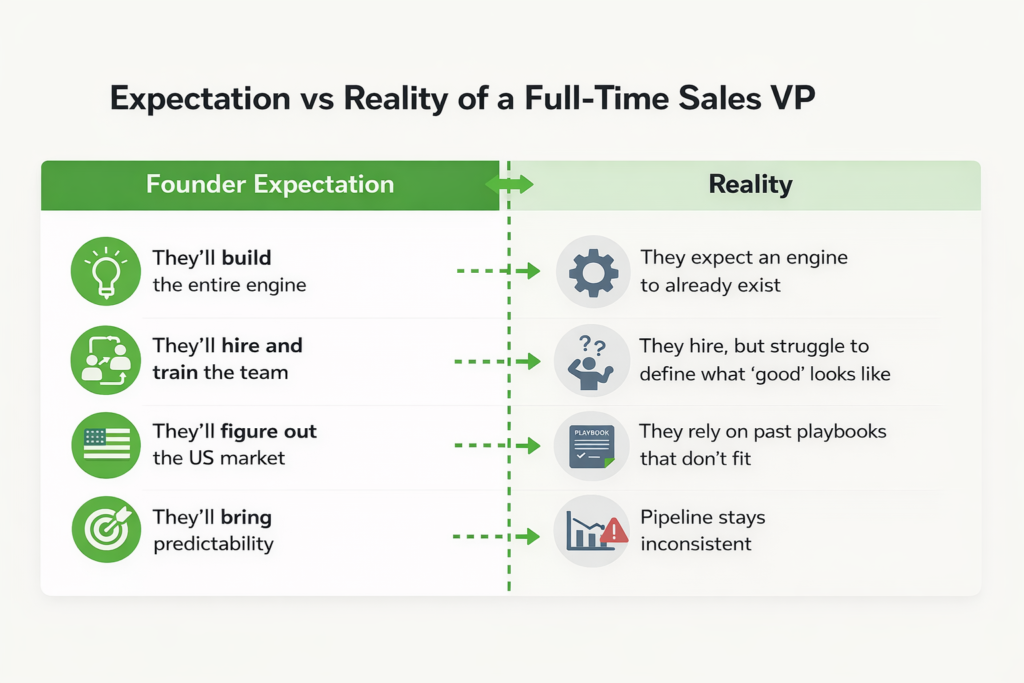
Yet the expectation from the new Sales VP is:
“Come in and build everything.”
That’s not leadership.
That’s asking someone to build a plane while flying it.
Why “Experienced” Sales VPs Often Fail in Startups
This is uncomfortable but important.
Many Sales VPs with 15–30 years of experience are excellent at:
- Managing large existing teams
- Optimizing mature revenue engines
- Reporting to boards
- Operating inside established GTM systems
But, what does a 0-1 company need?
- Building GTM from zero
- Creating ICPs from messy data
- Writing outbound messaging themselves
- Running early SDR experiments
- Getting hands-on with tools, workflows, and AI
- Training first-time SDRs and AEs
The result?
A dangerous mismatch between what the startup needs and what the VP is wired to do.
The Real Cost of One Wrong Sales VP Hire
This is where things get painful.
A senior Sales VP typically costs:
- Base salary: $180K–$250K
- Variable + benefits: $50K–$80K
- Time to impact: 6–9 months
- Severance / replacement cost if it fails: 3–6 months
But that’s not the real damage.
The hidden costs are far worse.
The Confidence Trap: “We’ll Know If It’s Working”
Founders often believe:
“We’ll know in 3–4 months if the VP is working out.”
In reality:
- Sales cycles in new markets are longer
- Early signals are misleading
- Activity looks high, outcomes lag
- Blame shifts to market conditions
By the time clarity emerges, the damage is already done.
Symptoms of a Failing Sales VP Hire
| Symptom | What It Really Means |
| “We’re still refining ICP” after 6 months | No clear GTM thinking |
| SDR churn increases | Poor hiring & enablement |
| Founder still closing big deals | VP hasn’t taken control |
| Pipeline looks busy, revenue doesn’t | Activity without strategy |
| “We need more time” | No repeatable system |
This Is Why Fractional VP Sales Exists
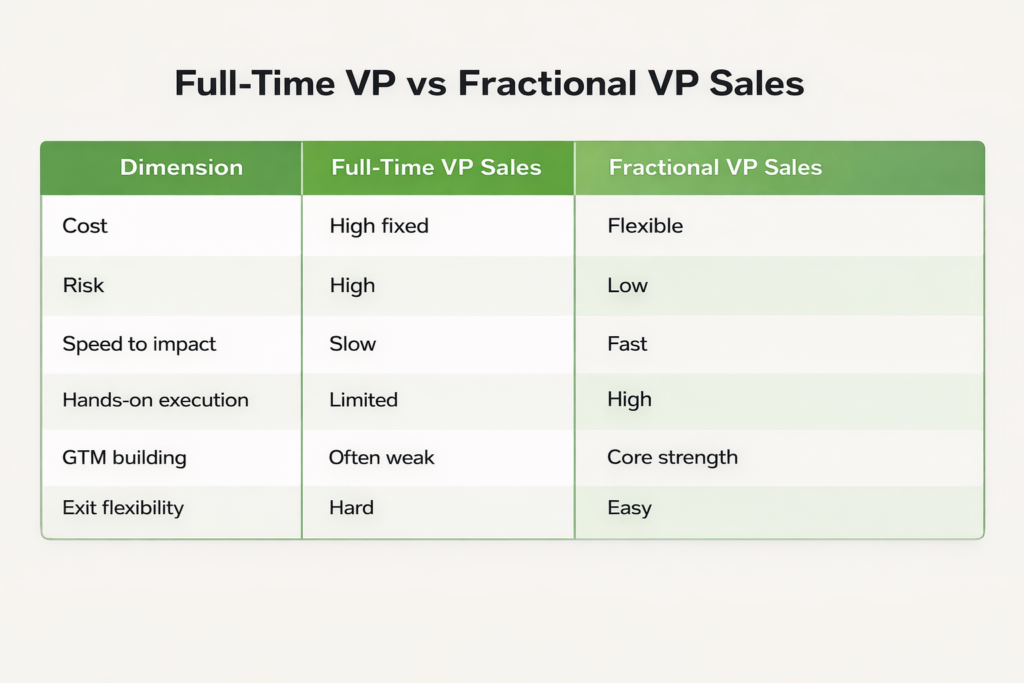
Fractional VP Sales isn’t a cost-cutting move. It’s a risk-management strategy.
Especially when:
- You’re entering new geographies
- You don’t yet have a sales operating system
- You’re transitioning from founder-led selling
What a Fractional VP Sales Actually Does (That Full-Time VPs Often Don’t)
A true Fractional VP Sales is not there to “oversee.”
They are there to build.
For a Fractional VP, this means:
- Defining a US / UK / EU ICP from scratch
- Designing outbound and inbound GTM systems
- Writing messaging frameworks
- Setting up SDR → AE workflows
- Installing RevOps and KPIs
- Training sellers hands-on
- Running revenue rhythm with leadership
- Using AI to accelerate sales execution
They don’t wait for systems.
They create them.
Why Fractional VP Sales Works Better for Market Expansion
When entering the US, UK, Europe, or Middle East, startups need:
- Speed
- Learning loops
- Tight feedback cycles
- Rapid iteration
Fractional VP Sales allows founders to:
- Test GTM assumptions without long-term risk
- Build internal capability instead of dependency
- Create playbooks that survive leadership changes
Once the engine works, then you hire full-time leadership.
Not before.
The Path to a $10M Revenue Engine
This isn’t about small wins.
It’s about building something that scales.
A $10M sales engine requires:
- Clear ICPs across regions
- Multi-channel GTM
- Predictable pipeline math
- Strong middle management
- Sales enablement at scale
- Revenue intelligence and AI workflows
Fractional VP Sales lays the foundation for all of this.
Without foundation, growth collapses under its own weight.
Final Thought: Don’t Bet the Company on One Resume
Hiring a Sales VP too early is one of the most common and costly mistakes startups make.
Not because Sales VPs are bad.
But because timing matters.
Before you hire someone to run the engine, make sure the engine actually exists.
Fractional VP Sales helps you:
- Build it
- Prove it
- Scale it
And only then; hand it over.